In Clinicfacial
Aqua Peel (Hydrafacial)
Medically reviewed by ChokChok · Updated March 27, 2026
Ask ChokChok AI
Get instant answers about Aqua Peel (Hydrafacial)
Try asking
Powered byCHOKCHOK
Korea's most popular clinic facial — a multi-step machine treatment that simultaneously exfoliates, extracts, and infuses skin with customized serums using a patented vortex technology.
How It Works
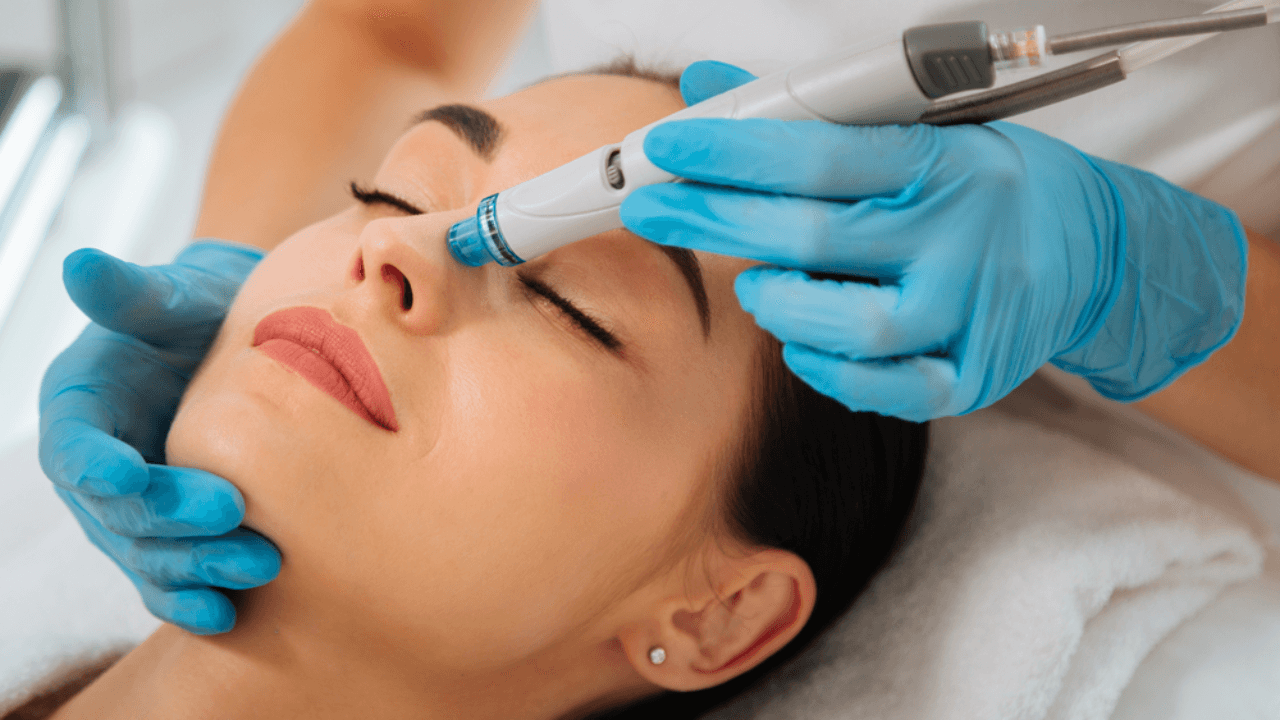
The aqua peel machine uses a spiral-tip handpiece that simultaneously delivers a chemical solution (typically containing salicylic acid, glycolic acid, and antioxidants) while vacuuming out loosened sebum, dead cells, and debris through suction. Unlike traditional facials, it does not use manual extraction. The spiral vortex creates a centrifugal force that drives the treatment solution into the follicle while extracting in the same motion. Clinics then infuse custom boosters (hyaluronic acid, growth factors, peptides) into the newly cleaned skin.
What to Expect
A typical aqua peel session runs 45–60 minutes. The aesthetician starts with a cleanse, then performs dermaplaning or basic exfoliation, then the aqua peel handpiece is passed over the face in sections (forehead, nose, cheeks, chin). You will feel a mild suction — not painful. The vortex tip will pull visible debris into the collection canister (satisfying to watch). A brightening or hydration booster ampoule is typically infused last. No downtime.
Deep Dive
The aqua peel is essentially the Korean version of Hydrafacial (an American brand). The Korean clinic version is often significantly cheaper ($50–100 vs $150–300 in the US/UK) and clinicians are typically more skilled due to high volume. It's the #1 performed facial treatment in Korea. Major clinic chains like Banobagi, Cinderella, and local피부관리실 all offer their version. Often combined with LED therapy post-treatment for enhanced results.
Pros
- ✓ No downtime
- ✓ Suitable for all skin types
- ✓ Immediately visible results
- ✓ Customizable boosters
- ✓ Gentle enough for sensitive skin
Cons
- ✗ Cost of regular sessions
- ✗ Results fade without maintenance
- ✗ Quality varies by clinic
Risks & Side Effects
- ⚠ Mild redness for 1–2 hours post-treatment
- ⚠ Very rare: sensitivity if over-suctioned
See It on TikTok
This is not medical advice. Always consult your healthcare provider or dermatologist before trying new treatments, especially in-clinic procedures.
Routines for Related Concerns
Step-by-step K-beauty routines that complement Aqua Peel (Hydrafacial).
Products That Complement Aqua Peel (Hydrafacial)
Products featuring the same key active ingredients — great for extending results between treatments.
Related Reading
Guide10 min read
The Spanish Eye Cream Hierarchy: Why Barcelona's Labs Own the Under-Eye Market
Spain has the deepest eye-cream bench in global beauty. We rank twelve eye treatments from Mesoestetic, ISDIN, Endocare, Natura Bissé, Sesderma, MartiDerm, Bella Aurora, Xhekpon, and BABÉ — from €8 pharmacy legends to €180 spa-grade formulas.
eye-creamspanish-pharmacyes-beauty
Guide7 min read
Rilastil: the Italian pharmacy workhorse dermatologists won't stop prescribing
Rilastil is the Italian pharmacy brand that Italian dermatologists actually prescribe — not the one influencers post about. Five decades of Ganassini family ownership, a clinical pipeline that prioritises reactive and atopic skin, and a catalogue so deep it covers everything from neonatal care to post-procedure recovery. Here's why it matters, what to buy first, and how it compares to the French pharmacy giants.
it-beautyrilastilitalian-pharmacy
Frequently Asked Questions
How often should I do Aqua Peel (Hydrafacial)?
Monthly to every 6 weeks. Most people see results within immediately glowing skin post-treatment; with monthly sessions, sustained clarity in 3 months.
Does Aqua Peel (Hydrafacial) hurt?
The pain level for Aqua Peel (Hydrafacial) is none. Downtime: None.
What are the risks of Aqua Peel (Hydrafacial)?
The main risks and side effects to be aware of: Mild redness for 1–2 hours post-treatment; Very rare: sensitivity if over-suctioned. Always consult a qualified provider, especially for in-clinic procedures.
How much does Aqua Peel (Hydrafacial) cost?
Aqua Peel (Hydrafacial) is in the mid-range range. Typical cost: $50–120 per session in Korea; $150–300 in US/UK.
Who is Aqua Peel (Hydrafacial) best for?
Aqua Peel (Hydrafacial) works best for oily, combination, acne-prone, sensitive, dry, mature skin, particularly those concerned with acne, pores, dullness, hyperpigmentation, dryness.


